5 Audio-Visual Sensor Fusion for Face Detection
Fusion of multimodal data is far less common than fusion of data
from the same sensor type. At present, little work in the literature
describes the actual fusion of passive sound and vision. Mak and
Allen [29] and Duchnowski et al. [28] describe the integration of lip
motion and sound data for improved speech recognition. In related
work, Bub, Hunke, and Waibel [51] use visual tracking of a human face
to cue an acoustic beamforming algorithm, which reinforces the voice
signal from an array of fifteen microphones. Each of these systems
assumes that only one person is in the camera view, since they cannot
distinguish which person is speaking. Takahashi and Yamasaki [52]
demonstrate the calculation of sound source localization by using
visual motion data to cue an adaptive FIR filter processing the
signal from six microphones. Wasson [49] detects multiple sound
targets and visual targets separately, associating them with one
another at the symbolic level. Sound targets detected outside the
camera field-of-view result in camera motion to confirm the target
positions visually. These works suggest that directional sound and
directional vision information may be used together for better
localization of speech activity.
5.1 Detecting Noisy Face Pixels
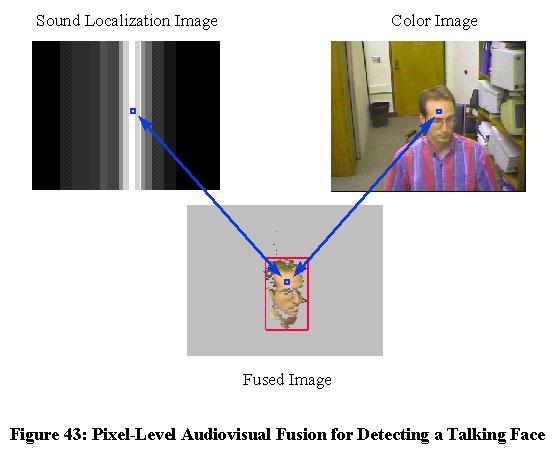
Rather than associating sound and vision at the symbolic level,
one may fuse this data at the pixel level. Given a spatially
distributed cellular representation of the world such as an image,
one may project sound information onto it and detect human activity
using sound and image measurements simultaneously. In effect, the
detector will look for "noisy" face-colored pixels. Figure 43
illustrates how 1-D sound localization data (normalized onset
correlation output) mapped to the same coordinates as the current
camera image allows pixel-level fusion of these two sensing
modalities. The main objective of this research is to use multimodal
data at an early level of processing to improve the reliability of
localization of the person speaking. If one combines sound
localization evidence supporting the proposition of a location in the
world being occupied by a person with visual evidence in support of
that location being occupied, a more accurate detector may be
designed.
Figure 43: Pixel-Level Audiovisual
Fusion for Detecting a Talking Face
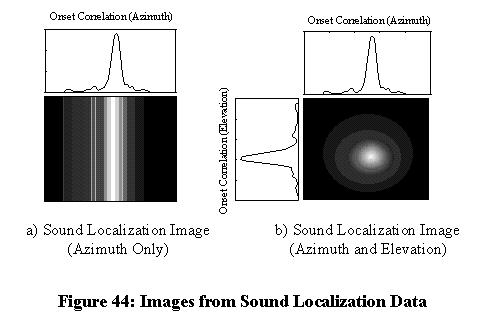
Figure 44: Images from Sound
Localization Data
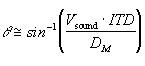
With only two microphones, onset correlation provides a 1-D
function of sound power versus azimuth, since interaural delay and
azimuth are related by Equation (1). Figure
44a shows this function mapped to a two-dimensional "sound image,"
where image brightness indicates the level of onset correlation. In
this example, it has been assumed that elevation is small enough that
each column of pixels relates directly to an interaural delay value.
(The actual locus of points defined by a given interaural delay is a
hyperbolic cone, but this is approximated as a vertical plane in
Equation (1).) If two orthoganal pairs of
microphones are used for onset correlation, then sound energy may
also be related to elevation. Figure 44b shows how onset correlation
plots for azimuth and elevation may be combined to create a 2-D image
of sound power. In this illustration, correlation values for
elevation and azimuth are multiplied together to form each pixel in
the sound image, thus highlighting the area where sound power from
each direction intersects. (Onset correlation values from two pairs
of microphones are statistically independent between azimuth and
elevation. This means that the probability that a sound originates at
a given azimuth and elevation may be calculated from the product of
the individual azimuth and elevation probabilities for the two onset
correlation plots. Multiplication of the raw correlation values
between the independent measurements is not exacly the same as
multiplying their probability densities conditional on the presense
of a sound target, but is close enough for illustration purposes
intended in Figure 44.) Only one pair of microphones was available
for real-time processing for the implementation done in this
research, so only the 1-D sound image is used in the remainder of
this dissertation.
5.2 Common Coordinates
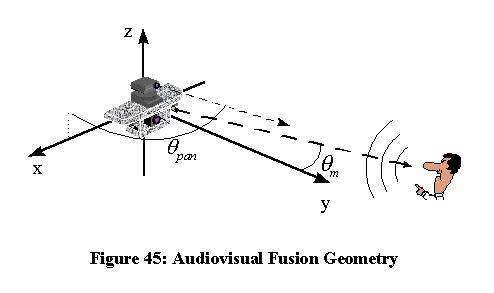
Sound localization and image pixel information both involve the
angle at which target data arrives at the sensor. If one positions
the cameras and microphones to share the same origin, then these
sensors may use the same polar coordinate system.
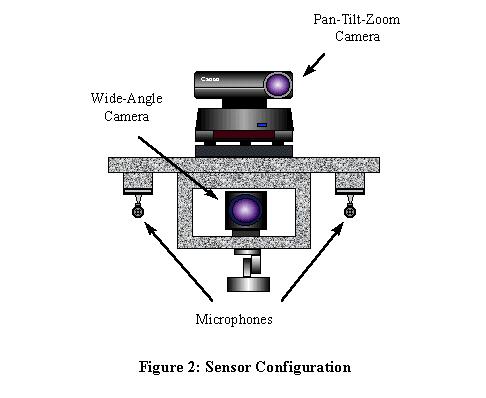
Figure 2 illustrates the placement of the
wide-angle camera between the microphones. Naturally, both cameras
may not be placed at the origin, so the pan-tilt-zoom camera is
mounted about 15 cm above the wide-angle camera. Note also that the
camera lens is horizontally offset about 3 cm from the center of the
camera, and that the optical axis does not run through the pivot
point. At close range, this less-than-ideal geometry adversely
affects the accuracy of position measurements and movements, but for
more distant targets, it may be ignored. Pixel-level fusion between
two cameras, as performed in applications such as stereo vision,
requires very precise alignment of optics. Sound localization data,
however, is much lower resolution than the image data, requiring less
precise alignment for fusion to take place and allowing a common
origin to be assumed for each. It will also be assumed that the
target's angle of elevation will be small enough that the estimation
of sound azimuth will be approximately equal to the visually measured
azimuth in polar coordinates.
Figure 45: Audiovisual Fusion
Geometry
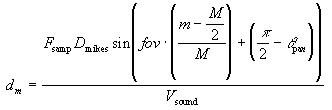
To create a 1-D sound image that is registered with the
current camera image, the pixel column number, m, must be
mathematically related to the corresponding interaural delay,
dm. This requires knowledge of the camera pan angle in radians
( pan), camera field-of-view
in radians (fov), and the image width in pixels (M).
Figure 45 shows the relationship between the camera pan angle, which
is measured with respect to the the x axis, and sound angle, m, which is measured relative to
the y axis (relative to the center of the field of view). For a given
image column m, the sound angle m is calculated as
pan), camera field-of-view
in radians (fov), and the image width in pixels (M).
Figure 45 shows the relationship between the camera pan angle, which
is measured with respect to the the x axis, and sound angle, m, which is measured relative to
the y axis (relative to the center of the field of view). For a given
image column m, the sound angle m is calculated as
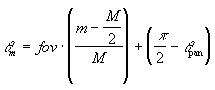
This sound angle is then used to calculate the corresponding
interaural delay, dm, as
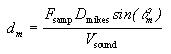
where Fsamp is the sampling frequency (44.1 kHz),
Dmikes is the the spacing betwen the microphones (0.30 m), and
Vsound is the speed of sound (approximately 344 m/s). A
similar calculation could be used for elevation data, if available,
using image rows and camera tilt.
Each column of the resulting sound image is set to the value
of the onset correlation,  , for the
corresponding interaural delay. This image provides a measure of
acoustic power relating to each location in the camera image.
However, in order to display the data as a gray-scale image like
Figure 44, it must be normalized by dividing
through by its maximum value. Such normalization is also used to
incorporate the sound data feature into the classifier described in
the next section.
, for the
corresponding interaural delay. This image provides a measure of
acoustic power relating to each location in the camera image.
However, in order to display the data as a gray-scale image like
Figure 44, it must be normalized by dividing
through by its maximum value. Such normalization is also used to
incorporate the sound data feature into the classifier described in
the next section.
5.3 A Bayesian Multimodal Pixel Classifier
A statistical classifier was designed to classify image pixels as
"Talking Face" or "Background" using the color and sound features
described in the previous two chapters. From Therrien [66], the
decision rule for a two-class minimum Bayes risk classifier is
expressed in terms of the probability density likelihood ratio as
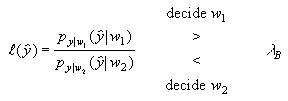 (7)
(7)
where
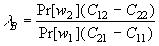
The terms  and
and  are the probability densities of
the measurement vector
are the probability densities of
the measurement vector  for classes
w1 and w2, respectively. Pr[w1] and
Pr[w2] denote the prior probabilities of the two classes, and
Cij is the cost of deciding on class wi when is actually from class wj.
for classes
w1 and w2, respectively. Pr[w1] and
Pr[w2] denote the prior probabilities of the two classes, and
Cij is the cost of deciding on class wi when is actually from class wj.
For a "noisy face pixel" detector, the measurement vector
may be broken down into two
vectors:  , the chromaticity of the pixel
under consideration, and
, the chromaticity of the pixel
under consideration, and  , the onset
correlation strength corresponding to that pixel angle. Sound and
color are assumed to be statistically independent features, allowing
their joint probability density to be expressed as the product of two
independent densities. For the two classes, "Talking Face" (F)
and "Background" (B), one may write these density functions as
, the onset
correlation strength corresponding to that pixel angle. Sound and
color are assumed to be statistically independent features, allowing
their joint probability density to be expressed as the product of two
independent densities. For the two classes, "Talking Face" (F)
and "Background" (B), one may write these density functions as
 (8)
(8)
and
 (9)
(9)
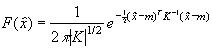
The probability density function for the chromaticity of face
pixels,  , was defined by a Gaussian
distribution in Equation (6) as discussed in
Chapter 4. The chromaticity density function
for background pixels,
, was defined by a Gaussian
distribution in Equation (6) as discussed in
Chapter 4. The chromaticity density function
for background pixels,  , depends on
the particular room and view where the image was taken. Since this
cannot always be known a priori, it may be approximated by a uniform
distribution in the color space, with a constant density value
, depends on
the particular room and view where the image was taken. Since this
cannot always be known a priori, it may be approximated by a uniform
distribution in the color space, with a constant density value  .
.
The sound onset correlation feature must now be defined. In
the previous section, the onset correlation,  , was related to the image pixel column m by
interaural delay,
, was related to the image pixel column m by
interaural delay,
 (10)
(10)
The cross-correlation value itself is awkward to use directly as a
feature for statistical classification since it is highly sensitive
to variations in gain and speaker volume. A normalized feature may be
found by dividing by the sum of the correlation values over the valid
interaural delay range:
 (11)
(11)
Other possible normalizations include scaling by the dynamic range
of :
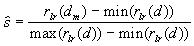 (12)
(12)
or dividing by the maximum:
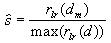 (13)
(13)
Since the onset signal value is always non-negative, the
cross-correlation value is always non-negative, and thus for all of
these functions,
 .
.
The probability density functions  and
and  could be
modeled for any of these representations of , and statistics gathered from experimental data to find
the corresponding model parameters. However, a different approach was
used in this work. The likelihood ratio
could be
modeled for any of these representations of , and statistics gathered from experimental data to find
the corresponding model parameters. However, a different approach was
used in this work. The likelihood ratio

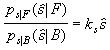
which represents the degree of belief in the "Talking Face" class
given sound information, should be lowest for = 0, highest for = 1,
and a monotonically increasing function in between. Since it is
difficult to fully characterize the exact probability density
functions given changes in range to the target and other variables, a
linear approximation for the likelihood ratio may be specified as
 (14)
(14)
The minimum Bayes risk decision rule in Equation (7) is now
rewritten for the talking face detector. Substituting equations (8)
and (9) into the expression for the likelihood ratio one obtains:
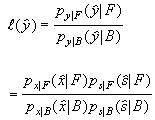
Next, Equation (6) is substituted for , kxB is substituted for , and
Equation (14) is used to replace the remaining terms, resulting in
the decision rule
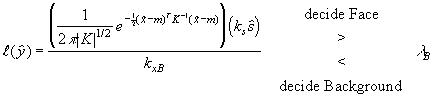 (15)
(15)
Factoring out constants for inclusion in the decision threshold,
one obtains
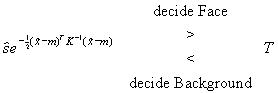 (16)
(16)
where

Because the costs Cij, prior probabilities, or constants
kxB and ks may not be known, one may determine the
decision threshold T empirically by running the system and
manually adjusting T until the best detector performance is
achieved. This technique was used for this dissertation project,
where the number of false positive and false negative classifications
were easily observable while the threshold was adjusted.
5.4 Performance Benefit
The addition of the sound localization feature to the face tone
information reduces the number of false positive detections of
talking face pixels by reducing the likelihood ratio of pixels that
do not correspond to the direction of sound. For the binaural case
considered in this dissertation, only one direction of sound
localization, azimuth, is available, so pixels in the image are
biased on a column-by-column basis. This still results in a
significant reduction in false positive detections since the image is
wider than it is tall and multiple faces usually appear beside one
another. Any reduction in the number of pixels marked as skin-colored
reduces the number of regions that must be analyzed further to
determine their acceptability as face regions. In fact, it reduces
the number of segmented regions to the point that the largest blob of
detected pixels is almost always the speaker's face.
The Bhattacharyya distance [66] may be used to bound the
probability of error on the classifier and quantify the performance
benefit of adding the sound feature. The Bhattacharyya distance is a
measure of separability between classes based on their probability
densities, and is defined as

A related quantity called the Bhattacharyya coefficient is
defined as
 (17)
(17)
For a minimum Bayes error classifier (Equation (7) with costs
Cij removed) the probability of error is bound by the relation
 (18)
(18)
called the Bhattacharyya bound. For the talking face pixel
detector, substituting the joint probability densities from Equations
(8) and (9) into (17) yields
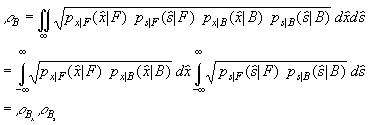
Since  shows the sound
feature's contribution to lowering the bound on the probability of
error.
shows the sound
feature's contribution to lowering the bound on the probability of
error.
A closed form solution for Equation (17) for Gaussian
probability densities is given in [66] as

Data from onset correlation experiments was manually sorted into
face and background samples, and the feature was generated using
Equation (13). The density functions and were matched to Gaussian
curves with sample means m1 = 0.7582 and m2 = 0.2785, and sample
variances K1 = 0.0439 and K2 = 0.0253, respectively. This resulted in
a calculated of 0.4270, meaning that the addition of sound
information to the original color classifier reduced the bound on the
probability of error by 57.3%. If two pairs of microphones were used
in orthogonal directions, one for azimuth and another for elevation,
the effect of would be squared, with a total error bound reduction of
81.7%.
For the color feature , the statistics of foreground and
background pixel samples in several images were processed to
calculate . The chromaticity means for face samples and office
background samples were
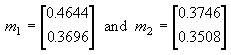
respectively, with covariances

This resulted in a  value of
0.5735. If one assumes that the prior probabilities of face pixels
and background pixels are 1/8 and 7/8, respectively, the
Bhattacharyya bound on the probability of error of is
(1/8)1/2(7/8)1/2(0.5735) = 0.1897 when using color information alone.
When the classifier also incorporates the sound data, the
Bhattacharyya bound drops to (1/8)1/2(7/8)1/2(0.5735)(0.4270) =
0.0810, meaning the classifier will provide the correct answer at
least 91.9% of the time.
value of
0.5735. If one assumes that the prior probabilities of face pixels
and background pixels are 1/8 and 7/8, respectively, the
Bhattacharyya bound on the probability of error of is
(1/8)1/2(7/8)1/2(0.5735) = 0.1897 when using color information alone.
When the classifier also incorporates the sound data, the
Bhattacharyya bound drops to (1/8)1/2(7/8)1/2(0.5735)(0.4270) =
0.0810, meaning the classifier will provide the correct answer at
least 91.9% of the time.
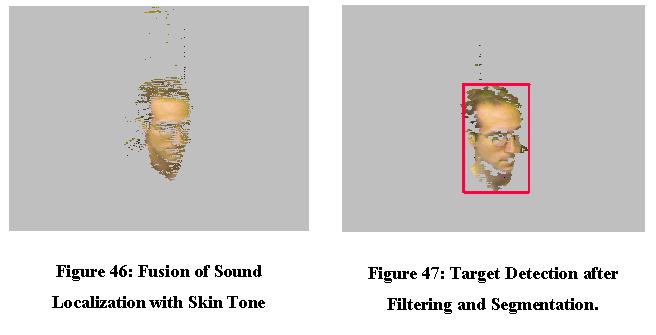
Figure 46 shows the detection of face pixels using both
sound and skin tone. Note how many skin-colored background pixels
such as those detected in Figure 41 have been eliminated in Figure
46. In this way, sound information is used to simplify the visual
task and improve performance. Figure 47 shows a similar frame after 3
x 3 filtering and region-growing to reduce noise and delineate the
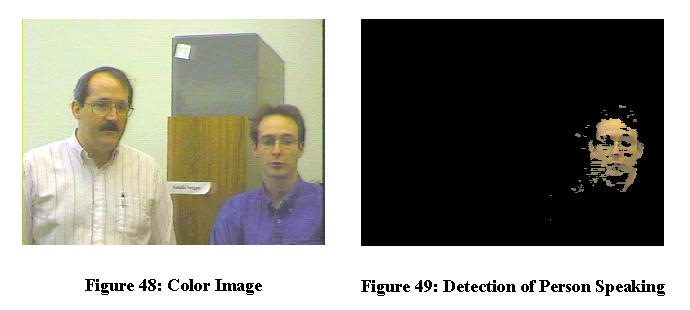
face region. Figure 48 shows two people within the camera's view,
with the person on the right speaking. Figure 49 shows the detected
skin-colored face pixels that correspond to the direction of sound.
This method allows non-speaking faces to be eliminated from
consideration without detecting and processing the regions they
occupy.
Figure 46: Fusion of Sound Localization
with Skin Tone
Figure 47: Target Detection after
Filtering and Segmentation
Figure 48: Color Image
Figure 49: Detection of Person
Speaking
This chapter has demonstrated how audio and visual
information may be combined during the classification of pixels.
After segmentation and region growing, the next task is to determine
which of the remaining regions is a face. One may use size, bounding
box aspect ratio, region moments, or other classifiers to make this
determination. A person's arm, for example, may appear in the image
and take up as much image area as the face. Region moments and
bounding box information can be used to dismiss such a region.
Ideally, background objects above and below the face will not be
skin-colored, simplifying the region selection task. Otherwise, a
more sophisticated face detector might be used, such as one based on
pattern analysis, or complementary information such as that from an
orthogonal microphone pair will be required. For this dissertation
project, however, simply choosing the largest segmented region (e.g.,
the box in Figure 47) was a surprisingly effective means of finding
the speaker's face for the requirements of camera control.
Next Chapter