2 Related Work
The research presented in this dissertation involves the use of
multimedia sensors and multisensor fusion and target tracking
techniques. Background information on the use of multimodal sensors
for human-computer interaction (HCI) applications is presented in
Section 2.1. Concepts in multisensor fusion are presented in Section
2.2.
2.1 Multimodal Systems
Research into machine perception of people spans multiple
disciplines, and approaches vary widely depending on the intended
application. While some work has been directed toward the goal of
creating anthropomorphic intelligent agents capable of recognizing
speech and conversing with people, other work has focused on
detecting human body movements as an input device to virtual reality
systems. Research topics in HCI technology that extend beyond the
keyboard and mouse to include input devices such as cameras and
microphones are often referred to as "multimodal interfaces." An
overview of many multimodal interface research goals and concepts is
provided by Waibel, Minh, Duchnowski, and Stefan [6].
The vast majority of literature to date describing multimedia
input devices involves component technologies such as speech
recognition working alone or added to the familiar keyboard-mouse-CRT
work environment. Another frequent assumption in these applications
is that the person being perceived is deliberately cooperating with
the perception process, e.g. speaking slowly and repeating
misidentified words, or holding their face centered in front of a
camera so their lips and expression may be observed. While this is
realistic for interactive applications where the person is working
directly with the computer, it is quite different from the passive
observation scenario described in this dissertation. However, each of
these component technologies is important for machine perception of
people, and they may be used together to form more intelligent
systems. Several of the core technologies in this area are described
below.
2.1.1 Speech Recognition
The recognition of spoken words in isolation or in the context of
a sentence is generally referred to as speech recognition, as
distinguished from speaker recognition, which refers to matching
sampled words with the identity of the speaker
(See Footnote 4). While speaker
recognition technology most often is targeted at security
applications, speech recognition research is by far the larger field,
intending to replace much of our use of the keyboard and make
computers more accessible. While speech recognition systems are still
far from perfect, commercial speech dictation software products are
available for multimedia PCs at the time of this writing, offering
word recognition rates of over 95% in dictation scenarios. Current
challenges facing speech recognition systems include speaker
independence, context-based recognition, removal of background noise,
and interpretation of natural language. While a thorough discussion
of speech recognition technology and relevant references is beyond
the scope of this dissertation, some specific techniques that have
been used to extend and enhance the recognition process through the
addition of other senses will be discussed later in this chapter.
2.1.2 Face Detection
The visual detection and localization of faces in a scene is a
useful technique for identifying people, and in the dynamic case,
measuring their behavior. In video communications between people, a
subject's upper torso and face are the most likely portions of the
body to be within view. If computers are ever to communicate with
people on an anthropomorphic level, machines will have to interpret
similar images and recognize the face as an important and diverse
human feature. Yet while the differences between our faces make it
possible to tell one another apart, these differences complicate the
task of automated detection and extraction of faces from a background
scene. Thus the localization process must be designed to detect what
is similar about human faces, distinguishing them from clutter in the
environment. In addition to human-computer interaction applications,
face localization is also useful in low-bandwidth video coding in
order to maximize the number of bits used in critical areas of the
face while reducing data elsewhere [7]. Numerous face detection
schemes based on neural networks [8,9,10], texture analysis [11],
fuzzy logic [12], symmetry measurement [13], motion detection [14],
background subtraction [15], and color segmentation [10,11,16,110]
have been reported. These detection techniques are discussed in
Chapter 4.
2.1.3 Face Recognition
In addition to localizing faces in the world, matching of faces
against images of known persons is also possible. Face recognition
algorithms implemented with neural networks [17,18], Bayesian methods
[19,20], and fuzzy logic [21] are described in the literature.
Besides making human-computer interaction more user-friendly, face
recognition technology also has applications for security-related ID
verification [22]. A survey of face recognition methods is provided
by Chellappa, Wilson, and Sirohey [23].
2.1.4 Facial Expression Recognition and Lip Reading
Human beings communicate a great deal of information about their
emotional state through their facial expression. Such information may
be useful to a computer in obtaining feedback about its performance
in interactive applications. Techniques recognizing human facial
expressions are discussed in [24,25,26]. Sensing dynamic changes in
face shape is also useful for lip reading, in both the silent
recognition case [27] or in conjunction with audio for performance
gains over sound-only speech recognition [28,29,30].
2.1.5 Body Tracking and Gesture Recognition
For surveillance, virtual-reality, and interactive "smart" room
applications, computer vision allows computers to track a human
being's position and body pose. The ALIVE system developed at the
Massachusetts Institute of Technology's Media Lab tracks human body
movements and uses them to control an animated version of the user in
a virtual world, rendered onto a large screen in real time
[31,32,33]. At Carnegie Mellon University, a 360-degree sensing
system integrating motion video from 51 cameras is used to capture
abundant 3-D depth information to determine human body position and
pose [34]. Simpler human-tracking systems using background image
difference [35,16] and motion detection [36] have also been described
in the literature. To detect nonverbal communication such as pointing
and waving, computer vision systems may employ gesture recognition
techniques [37,38,39].
2.1.6 Sound Localization
The inter-aural signal differences between two or more microphones
allow the direction of a sound source to be estimated. This
information is useful for aiming a camera at the source, focusing a
beamforming microphone array on the source, and for identifying which
person or object caused the sound. Inter-aural signal differences
include Interaural Time Difference (ITD) and Interaural Intensity
Difference (IID). ITD provides a measure of the difference in
distance to the target from each microphone, allowing triangulation,
and is frequently calculated using cross-correlation techniques
[40,41,42,43]. Additional sound localization systems are presented by
[44,45,46,47].
At the time of this writing, PictureTel, a leading
videoconferencing systems manufacturer, has begun marketing an
automatic camera control system called LimeLightTM which uses sound localization to point the camera
at the person speaking. Camera control research platforms using
similar schemes are described by [16,48,49]. Beamforming systems,
which remove background noise and improve sound quality by
electronically steering a microphone array at the desired source, are
presented by [48,50, 51,52].
2.1.7 Audio-Visual Fusion
Descriptions of sensing methods that combine both acoustic and
visual sensing are quite rare in the literature. The most prevalent
are the lip reading systems previously described, which involve close
time registration of audio and visual data, but have no concern for
spatial registration due to the assumption that only one voice and
one face are present. Spatial data association between multiple
visual targets and multiple sound sources is described by Wasson
[49]. Wasson's system performs symbolic data association after
discrete sound and visual targets have been detected separately.
Pixel-level fusion used to reinforce spatial sound and motion vision
information is described by Takahashi and Yamasaki [52]. In this
dissertation, the synergistic use of sound localization data and
color vision at an early level of processing will be used to detect
people.
2.2 Sensor Fusion
The terms sensor integration and sensor fusion both refer to the
use of multiple sensor data in an intelligent system. A common, but
not universally accepted, distinction may be made here. Sensor
integration usually refers to the use of the multiple sensors to
provide information for different sub-tasks during different modes of
a system's operation. An example may be an industrial robot that uses
a vision system to locate parts, and a touch sensor to assist its
grasp while lifting a part, but segregates these sensing modalities
to different steps in the task. Sensor fusion usually refers to the
combination of multiple sensor data into one representation or
control action, for improved measurement accuracy or motor behavior.
For example, a robot might use the combined features of weight,
shape, and color to classify and sort objects. Or, it might fuse
multiple sensor readings to localize itself or objects in its
environment. The boundary between integration and fusion is fuzzy
and, for the most part, arbitrary. The distinction is made only to
draw attention to the more difficult problems associated with sensor
fusion, such as finding a common representation for data from
multiple sensor types, resolving differences between measurements,
and registering sensors to one another.
Sensor fusion may be performed on time series, redundant, and/or
complementary sensor data. Time series fusion, by far the most
common, allows for filtering of noisy sensor data and is commonly
used in target tracking applications. Redundant sensors acquire data
in parallel, and allow comparisons to be made among simultaneous
readings. An example of this is the use of multiple ultrasonic range
finders on a mobile robot for obstacle detection and avoidance.
Complementary, or multimodal sensor fusion incorporates information
about different physical aspects of the environment. This multimodal
case is of special interest to our audio/visual tracking system.
Multimodal sensor data is often used in recognition and world
modeling tasks.
Applications of multisensor fusion may be characterized by the
level of representation given to data during the fusion process, and
by the mathematical foundation upon which the fusion operation is
based. In Section 2.2.1, the issue of levels of representation are
explored. In Section 2.2.2, the theoretical basis for several popular
fusion techniques are compared.
2.2.1 Levels of Representation in Sensor Fusion
The form taken by sensor data at the point of fusion varies
depending on how early in processing this combination takes place.
Luo and Kay [53] describe four common levels of fusion: signal level,
pixel level, feature level, and symbol level, to which a fifth,
behavior level, may be added. A comparison of fusion levels is given
in Table 1, adapted from [53] with the addition of behavior level
fusion.
Table 1: Comparison of Fusion Levels
(adapted from [53])
|
Characteristics
|
Signal Level
|
Pixel Level
|
Feature Level
|
Symbol Level
|
Behavior Level
|
|
Type of sensory information
|
single or multi-dimensional signals
|
multiple images
|
features extracted from signals / images
|
symbol representing decision
|
motor action
|
|
Representation level of information
|
low
|
low to medium
|
medium
|
high
|
low
|
|
Model of Sensory Information
|
random variable corrupted by noise
|
stochastic process on image or pixels with
multidimensional attributes
|
geometrical form, orientation, position, and
temporal extent of features
|
symbol with associated uncertainty measure
|
reaction to stimuli in the form of motor
signal/vector or motivational state
|
|
Degree of registration
spatial:
temporal
|
high
high
|
high
medium
|
medium
medium
|
low
low
|
medium
high
|
|
Means of registration
spatial:
|
sensor coalignment
|
sensor coalignment, shared optics
|
geometrical transformations
|
spatial attributes of symbol, if necessary
|
geometrical transformations, if necessary
|
|
temporal:
|
synchronization or estimation
|
synchronization
|
synchronization
|
temporal attributes of symbol, if necessary
|
synchronization
|
|
Fusion method
|
signal detection and estimation
|
image estimation or pixel attribute combination
|
geometrical and temporal correspondence, feature
attribute combination
|
logical and statistical inference
|
weighted summation, fuzzy rules, subsumption,
artificial potential fields, or neural nets
|
|
Improvement due to fusion
|
reduction in expected variance, improved
detection
|
increase in performance of image processing tasks
|
reduced processing, richer, more accurate feature
data
|
increase in truth or probability values
|
increase competence in real-time reactions
|
Note that these levels of fusion are only a rough classification
of representation possibilities, and in no way can capture the
subtlety of numerous applications. For instance, pixel-based images
such as those used in medical imaging may be treated as spatially
discrete two-dimensional non-causal signals. Despite the obvious
pixel-based representation of these signals, the mathematical
techniques used to process and fuse this data are more closely
related to signal-based techniques [54,55,56]. In contrast, cellular
spatial models of the world often benefit from pixel-level fusion
techniques. Range signals from sensors such as sonar and laser-radar
may be incorporated into a grid model to synthesize an "image" of the
environment for extraction of features as a later step [57], [58].
2.2.1.1 Signal-Level Fusion
When one hears an insect buzzing above and behind one's head, one
can approximately localize and track the insect using the information
one's ears provide over time. Such is an example of signal-level
fusion. Inter-aural time and intensity differences in the ears are
processed to provide an estimate of the insect's position. One's
hearing becomes tuned to the sound detected, and the accumulation of
direction measurements gives one a more accurate estimate of its
location.
Approaches to signal-level fusion incorporate multi-sensor or
time-series data to improve the quality of the signal. The most
common techniques consist of filtering or weighted averaging. An
overview of the popular Kalman filtering method is given in
Chapter 6.
2.2.1.2 Pixel-Level Fusion
When an object moves within one's field of view, the time
variation of the image projected onto the retina is detected as
motion. The point of activity on the retina maps directly to the
target's azimuth and elevation in space. This type of pixel-level
fusion demonstrates the power of a data representation that contains
implicit spatial information in its structure.
Pixel-level fusion may be performed on time-series images, images
from stereo or trinocular cameras, or multiple sensors with shared
optics. Additional types of sensor measurements may be fused into
images that serve as cellular representations of the world.
Time-series pixel data can be used for optical flow and target
tracking, while stereo or trinocular fusion allows extraction of
depth information through triangulation of matched pixels in each
image. Images generated by different sensors types through separate
apertures are difficult to fuse due to the registration problems of
parallax and image warping. To simplify this, some multimodal imaging
systems use shared optics. An example of fusion between manually
registered forward-looking infrared and intensity images for
automatic target recognition is given in [59]. In such cases, a
multimodal vectored pixel element can provide greater sensitivity in
the detection phase than can the original, unregistered scalar pixel
elements of either sensor.
Cellular world models also present an opportunity for pixel-level
fusion from the same or multiple sensor modalities. In medical
imaging, for example, tomagraphic techniques are used to synthesize
images from sensor data for CT, MR, and PET scans. Elfes [57]
demonstrates the fusion of multiple ultrasonic rangefinder
measurements into a probabilistic map of occupied spaces. Beckerman
[60] uses a 2-D cellular world map for the fusion of visual and
ultrasonic sensor data. Richardson and Marsh [61] demonstrate the
fusion of elevation data from downward-looking ultrasonic range
measurements and structured lighting vision to form an elevation map
of an object.
2-D or 3-D cellular maps of the environment are powerful
representations for fusing sensor data. They can directly represent
spatial relationships between areas of the world for which data is
available, without increasing in size as more data is gathered.
Sensors of different spatial resolutions may be represented by
choosing a cell size appropriate for the highest resolution sensor
and blurring the projection of lower-resolution data onto the map. On
the down side, processing of cellular models may be computationally
intensive, and require large amounts of memory, especially when
fusing time-series pixel data.
2.2.1.3 Feature Level Fusion
When one negotiates a staircase, one can locate the limits of the
stair treads by noting the edges due to boundaries of color and
texture, and abrupt differences in depth. One may also feel the tread
with one's foot. The fusion of these different features provide a
reliable position estimate for the stair edge.
Feature level fusion involves the sensory extraction of object
features in the environment so that they may be matched to
corresponding features in a symbolic world model. For instance, a
mobile robot may measure the distance to walls using sonar, and
detect the straight edges of walls and doors using vision. It may
then match these features to a geometric map of world to estimate its
position or update the map. Wallner and Dillman [62] use
feature-level fusion to match stereo vision and sonar data to a
parametric model of an indoor environment. Cox [63] demonstrates the
matching of infrared range data to a geometric map. Abdulgafour and
Abidi [64] fuse edge features from intensity and range images for
better segmentation of facets of geometric objects. Broida [65]
illustrates a technique for matching features detected in multiple
sensor measurements.
2.2.1.4 Symbol-Level Fusion
When used together, symbols like the words apple, serpent, garden,
deity, and Eve can evoke a specific idea in one's brain. Visual or
acoustic information is used to detect the words, then symbolic
reasoning and memory recall take over. Using relationships between
symbols, and between one's senses and symbols, allows high-level
logical decision making and a more compact representation of
concepts, especially for information processed computers.
The most common type of symbol-level fusion is pattern
recognition. Feature information is extracted from sensor data,
defining a point in feature-space. This point may be mapped to a
symbolic interpretation of the world based on that symbol's
neighborhood in feature space. Such a neighborhood function may be
defined by probability theory [66], Dempster-Shafer's theory of
evidence [67], crisp or fuzzy logic [68,69], neural networks [70], or
other means.
In problems such as speech recognition, the classification task
involves multiple inter-dependent classifications. Vocabulary, rules
of grammar, and context can greatly assist in constraining the range
of possible phonemes or words that match a particular sequence of
data. The Hidden-Markov Model approach to this problem is described
in [71]. Duchnowski et al. [28] demonstrate improvement of machine
speech recognition through the addition of visual lip-reading.
Symbol-level fusion usually assumes that sensor measurements
correspond exclusively to the specific object (e.g., an unidentified
target) or event (e.g., an unidentified phoneme spoken) that caused
them. If measurements of multiple objects or events are present in
the data set, proper association must be performed before recognition
and symbolic reasoning can be performed. Given the complexity of the
data association problem and difficulty of data separation in some
cases, most descriptions of symbolic reasoning schemes ignore cases
where multiple objects or events could be present in the data, e.g.,
multiple faces in an image [28], multiple people speaking at once
[71], or affliction by more than one disease [72]. Given this
dissertation's application of tracking people in a room where
multiple people and sound disturbances will be present, it is obvious
that these recognition techniques will not work without proper data
association and separation, where appropriate.
2.2.1.5 Behavior Level Fusion
When one reaches to activate a light switch, multiple motor skills
are simultaneously responsible for guiding the limb. One's reach
begins with a ballistic motion, using an estimation of the dynamics
necessary to reach that target in space. As the hand draws near the
switch, one may visually correct the motion if it is off-target. Upon
contact, the sense of touch provides feedback for fine adjustments to
properly activate the switch. During much of the motion, more than
one of these low-level control processes are active at once, a fact
of which one is not acutely aware. This is evidence of a type of
low-level behavior fusion, where multiple control behaviors overlap
and combine to perform tasks smoothly.
Behavior fusion is useful for intelligent systems that must
perform autonomous activities based on sensor information. For many
years, research in robotics and artificial intelligence was dominated
by the sense-model-plan-act paradigm, where all control actions were
deliberatively determined from an internal world model and
subsequently executed. The problems with this approach were the poor
reliability of a world model constructed from noisy, uncertain sensor
data, and the inability to incorporate and react to new sensor
information in a time-effective manner. As a result, autonomous
robots and systems did not perform well in unstructured environments.
However, a new paradigm recommended by Brooks [73] proposed that
robot control be broken into parallel, concurrent reactive behaviors
that could interact with one another and respond to new sensor data
in real time. Each behavior would be competent in its own limited
domain, and subsumed by other behaviors when the robot was outside
that domain. Rather than planning a path around every object, a
robot's goal seeking behavior could simply attempt to drive toward
the goal, but would be overridden by an obstacle avoidance behavior
when its path was not clear. Robots designed around this philosophy
proved to be faster, far more responsive to environmental stimuli,
and able to recover gracefully from mistakes [74,75].
Several techniques exist for combining separate behaviors. In
Brooks' subsumption architecture [73], behaviors can operate
concurrently, especially when affecting different actuators, such as
an arm and a wheel, or can be switched on and off by a hierarchy of
finite state machines. Sensor measurements and timers were used to
determine state transitions, with limited use of internal world
models. Arkin [76] uses artificial potential fields to fuse control
recommendations from multiple behaviors, which he calls "schemas."
Pin et al. [77] define reactive robot control behavior using fuzzy
rules processed by custom VLSI fuzzy inferencing hardware. Goodridge
and Luo [78], Goodridge, Luo, and Kay [79], and Goodridge [80] use an
efficient fuzzy control inference kernel to define and fuse a
hierarchy of behaviors for mobile robot guidance. Fuzzy rules define
separate reactive behaviors as well as the way in which these
separate recommendations are blended into the motor control signal.
This technique allowed the mobile robot MARGE to win an event at a
national competition for intelligent mobile robots in 1993 [81].
Behavior-level techniques cannot completely replace high-level
planning and reasoning. Rather, they provide a degree of real-time
low-level competence in reacting to sensor data, while higher level
processing may optimize strategies and assign sub-goals. In some
applications, however, behavior-level fusion provides graceful
degradation and error recovery well enough that high level planning
becomes unnecessary [80]. We may also find this to be true for the
application of tracking a human being; for example, losing track of
the current speaker may be gracefully recovered from by a behavior
such as widening the field of view until the system regains a
reliable track.
2.2.2 Computational Methods
Independent of the level of representation used, a variety of
popular mathematical techniques for sensor fusion appear in the
literature. These methods generally perform a data-reduction mapping
from multiple inputs to a smaller number of outputs. Inputs may be
raw sensor readings, pixel values, extracted features, signal
estimators, or control signals; outputs may be estimated state,
recognized objects or events, enhanced features, control signals,
etc. In this section, the strengths and weaknesses of each method
will be explored. An important aspect of each technique is the way in
which it models uncertainty in sensor information. An excellent
overview of uncertainty formalizations, and the relationships between
them, is given by Klir [82].
2.2.2.1 Probability and Bayesian Inference Techniques
Probability theory, which measures the likelihood of an event, was
first developed by Blaise Pascal in the 17th century as a means of
solving gambling problems. It was later advanced by Thomas Bayes in
the 18th Century and by Pierre de Laplace in the early 19th century.
Probability-based inference techniques have withstood mathematical
scrutiny for hundreds of years, and are the foundation of most sensor
fusion applications.
The basic assumption of probability-based sensor fusion is that
the uncertainly in sensor information may be modeled by uncorrelated
random noise. (However, Beckerman [60] demonstrates a Bayesian
Maximum Entropy technique for multisensor fusion given non-random
systematic noise.) Decision and estimation rules based on probability
include mean-square error and maximum a-posterior probability (MAP),
which minimize the probability of error, Bayes risk, which minimizes
the probable cost of error, and maximum likelihood, which estimates a
parameter without assuming a prior probability distribution for
values of the parameter. An introduction to these methods is given in
[66].
Probability theory provides optimal decision and estimation
results for systems in which accurate statistics can be gathered or
calculated from the structure of the problem. The testing of a
probability-based decision system requires determining frequency
ratios through experimentation. This reinforces the widely held
frequency definition of probability, disputed by Cheeseman [83],
which he describes as follows:
The probability of an event (hypothesis) is the ratio
of the number of occurrences (n) in which the event is true to the
total number of such occurrences (m).
Cheeseman argues that the frequency definition of probability is
unnecessarily limiting, and that probability may be applied to more
general applications of uncertainty in artificial intelligence if a
different definition is accepted [83]:
The (conditional) probability of a proposition given
particular evidence is a real number between zero and one, that is a
measure of an entity's belief in that proposition, given the
evidence.
Cheeseman points out that this belief definition of probability is
more intuitive than the frequency definition. It allows probability
theory to be applied to AI systems which attempt to model degrees of
belief, and may be a superior replacement to theories such as
Dempster-Shafer's theory of evidence and fuzzy logic. Cheeseman is
correct in his assertion that probability is equivalent or superior
to these other techniques in many applications. However, it is the
opinion of this author that the approaches taken by the inventors of
these alternatives have contributed much to the understanding of
uncertainty in intelligent systems, and have expedited the
development of successful applications. For this reason, the
alternative methods in question are included in this review.
Probability theory provides the foundation for optimal
filter/estimators such as the Kalman Filter, described in Chapter 6,
which is used in many applications for target tracking, robot
localization, and system control. Examples of Bayesian techniques for
fusion of sensor data into cellular maps are illustrated by Elfes
[57], Beckerman [60], and Richardson and Marsh [61]. MAP decision
rules provide a powerful means for pattern recognition and
classification [66,71]. Bayesian techniques are commonly used for
image restoration and pixel classification [55,54,56].
2.2.2.2 Dempster-Shafer Theory of Evidence
The theory of evidential combination proposed by Dempster [84] and
extended by Shafer [67] models uncertainty as belief in one or more
propositions or ignorance. The set of all possible mutually exclusive
hypothesis is called the frame of discernment, . With each evidential proposition, one or more members
of the power set of (denoted 2^) are assigned a basic probability
assignment (bpa) number in the range [0, 1]. One member of 2^, denoted simply as, is assigned a bpa representing a
proposition's ignorance of which hypothesis is correct. This
representation of ignorance is what makes Demster-Shafer reasoning
different from probability For instance, in probability theory, the
probabilities of mutually exclusive hypothesis sum to one, that is,
. With each evidential proposition, one or more members
of the power set of (denoted 2^) are assigned a basic probability
assignment (bpa) number in the range [0, 1]. One member of 2^, denoted simply as, is assigned a bpa representing a
proposition's ignorance of which hypothesis is correct. This
representation of ignorance is what makes Demster-Shafer reasoning
different from probability For instance, in probability theory, the
probabilities of mutually exclusive hypothesis sum to one, that is,
Pr[A] + Pr[ ¬A] = 1.
In the Dempster-Shafer Theory, the bpa belief mass for each
mutually exclusive hypothesis may sum to less than one:
m(A) + m(¬A) <= 1
where, instead,
m(A) + m( ¬A) + m( ) <= 1
Evidence gathering accumulates belief in each hypothesis set Ck
(subset of 2^) according to
Dempster's rule of combination:
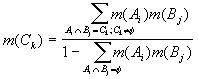
The belief of a hypothesis set Ck is defined as
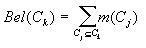
The plausibility of the hypothesis set Ck is define as one minus
the belief in the complement of Ck:
Pls(Ck) = 1 - Bel( ¬Ck)
As evidence is gathered, the rule of combination increases the
belief and plausibility of those hypotheses supported by the
evidence, and decreases the bpa of the ignorance factor, (. If no
weight is assigned to ignorance, Dempster's rule of combination
reduces to basic probability theory. It is intuitively appealing to
model ignorance in this way, especially when evidence is supplied
from human experts. Indeed, Dempster-Shafer reasoning is often
applied to expert systems that reason using epistemic, more often
than aleatory, representations of belief.
An illustration of the Dempster-Shafer theory applied to medical
diagnosis is given by Gordon and Shortliffe [85]. Stein [86] gives an
example of finding the most likely suspect of a crime using
subjective interpretation of evidence. In more quantitative
applications, Lee [56] and Lee and Leahy [54] compare the use of
Dempster-Shafer, MAP, and maximum likelihood algorithms for
multi-sensor image segmentation problems, showing a marginal
improvement in the results of the Dempster-Shafer implementations
over MAP. (ML ignores the prior introduced by a Markov Random Field
used in the other methods and, therefore, resulted in a much higher
misclassification rate.)
Hughes and Murphy [58] apply Dempster-Shafer reasoning to a
cellular world map constructed from sonar data. By assigning degrees
of ignorance to cells for which little or no data is available, their
method can distinguish between unmapped areas and cells which show
inconsistent data, or "strife," after repeated measurements.
Consequently, a cell with equal probability of being empty or
occupied may be thought to exist on an edge or in a dynamic region if
ignorance is low. This differentiation from unmapped cells is not
possible with the Bayesian mapping technique presented by Elfes [57].
Hutchinson and Kak [87] demonstrate dynamic planning of sensing
strategies to minimize ambiguity through Dempster-Shafer reasoning in
recognition of geometric objects. They generate 2-D and 3-D features
using structured lighting and intensity images, as well as
force/torque features from sensor in the wrist of a robot
manipulator. Sensing strategies are chosen dynamically by searching
for the next sensing operation that would minimize the maximum
ambiguity in the resulting hypothesis set given the evidence present
at each iteration.
The advantages of Dempster-Shafer evidential reasoning are best
displayed in applications that: (a) combine subjective expert
knowledge, (b) involve class hierarchies of hypotheses, and (c)
benefit from the explicit modeling of ignorance and strife as
separate uncertainty metrics. However, Cheeseman [83] argues that
these features can be provided equally well by Bayesian techniques.
For instance, it is possible to measure the probability of error in a
probability estimation; this value decreases with the addition of
evidence just as the Dempster-Shafer "ignorance" value does. Given
the strong mathematical history of probability theory,
Dempster-Shafer reasoning remains controversial, but it has
nevertheless enabled some significant applications of data fusion in
uncertainty.
2.2.2.3 Fuzzy Logic and Fuzzy Control Behaviors
Fuzzy set theory, originally developed by Zadeh [68] in the 1960s,
has become a popular tool for control applications in recent years.
The principle behind this field allows ambiguous information to be
classified into sets that do not have crisp boundaries; hence the
name "fuzzy sets." Given a measurement x, a fuzzy set A is said to
contain x with a degree of membership defined as µA(x), where
µA(x) can be any value in the continuous domain [0,1]. Fuzzy
sets are usually named after adjectives, such as TALL; the membership
function described as µTALL(x) would therefore reflect the
similarity between values of x and the contextual meaning of TALL. If
x represented a person's height in centimeters, and TALL were used to
classify "tall men," then µTALL might have a membership function
equal to zero below 150 cm, equal to one over 185 cm, and a smooth
curve of fractional values between these limits. The degree of truth
of a statement like "If Bob's height is TALL ..." is evaluated by
calculating the value of the membership function for Bob's height. A
fuzzy set may also be thought of as a distance metric for the
comparison of quantitative data. Fuzzy set memberships are often take
the shape of Gaussian, trapezoidal, or sigmoidal functions.
Logical manipulation of fuzzy memberships requires the extension
of crisp logic operations to fuzzy sets. The three fundamental
logical operations, intersection, union, and complement, have fuzzy
counterparts popularly defined as follows:
Intersection ( x is A ) AND ( y is B ): A and B = min (
µA(x), µB(y) )
Union ( x is A ) OR ( y is B ): A or B = max ( µA(x),
µB(y) )
Complement ( x is not A ): ¬A = 1 - µA(x)
Applications using fuzzy techniques can generally be divided into
two groups: fuzzy logic, and fuzzy control. In fuzzy logic, fuzzy
sets provide a multi-valued belief representation for
constraint-based reasoning. They also provide a way to characterize a
region of an expert system's potentially large input space, using
linguistic terms that are easy for human beings to specify. Fuzzy
systems may be adaptively trained to partition the input space and
develop rules for recognition and classification tasks. Gibson, Hall,
and Stover [88] demonstrate the application of fuzzy logic to
automatic target recognition. Abdulghafour and Abidi [64] use fuzzy
rules to fuse edge data from range and intensity images for better
image segmentation. An introduction to fuzzy reasoning and
applications may be found in [69].
The most popular application of fuzzy techniques is for control
systems. Fuzzy sets and rules allow a system designer to define
control signal recommendations at various points in the controller's
input space. The shapes of the fuzzy sets used define the
interpolation that occurs between fuzzy rules. This provides the
capabilities of a nonlinear control surface without complex
mathematics; rather, the system designer only needs an intuitive
sense of the problem in order to write linguistic rules. The output
of a fuzzy controller may be determined using the centroid of the
fuzzy rule recommendations as follows: If each rule i prescribes an
output value of oi with an antecedent certainty of wi, then the
output of a controller with N rules is calculated as follows:
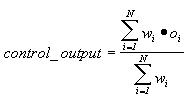
Fuzzy control allows the representation of one form of
uncertainty, "vagueness," in the description of control rules. It
does not assume to represent the behavior of random events, and thus
has no counterpart in probability theory. It is therefore relatively
immune to the criticisms of fuzzy set theory and fuzzy logic by those
advocate purely probabilistic models of uncertainty. Some examples of
applications of fuzzy control may be found in [89,77,90,91,78]. In
earlier work, the present author used multiple layers of fuzzy
controllers to define control behaviors for a mobile robot [80].
Similar techniques may be used in order to control a pan-tilt-zoom
camera according to qualitative expert rules for the surveillance and
videoconferencing applications presented in this dissertation.
2.2.2.4 Neural Networks
Inspired by the connection-oriented architecture of biological
intelligence and sensory systems, adaptive learning through
artificial neural networks has received considerable attention in the
areas of pattern recognition [92] and control systems [93]. Much of
this work followed the development of gradient-descent learning
training algorithms for multi-layer feedforward networks during the
1980's, spurred by the recent increase in availability of computing
power for iterative calculations. An introduction to neural network
techniques, including feedforward nets, supervised training by
backpropagation, Kohonen nets, and Hopfield nets is provided in [70].
Unlike fuzzy systems, whose pattern classification or control
mapping function is usually directly programmed by a human expert,
neural systems adapt to example training data using supervised (e.g.,
backpropagation) or unsupervised (e.g., Kohonen) learning techniques.
The objective of training the network is to generalize the
classification or control mapping from the sample data. Early in
training, a feedforward network's neurons have low activation levels,
providing very shallow transitions between regions in the input
space. These slopes steepen as training progresses, until the
function closely matches outputs required for the sample data at
those points. Training is usually stopped as soon as a minimum error
threshold is reached in order to prevent overtraining, which can
adversely affect generalization. Classification neighborhoods
realized by multilayer neural networks can take virtually any shape.
In contrast, Bayesian modeling and classification usually involves a
limiting assumption of the shape of the density functions, e.g.,
Gaussian. For many complex systems, neural networks provide a
powerful means for adaptive learning of a classification or control
mapping.
Out of the variety of multimedia and sensor fusion topics covered
in this chapter, the following concepts apply directly to the
research presented in this dissertation:
- Complementary information from multimodal sensors:
While vision allows the detection of faces, sound localization
determines which face is of primary interest to the computer. Both
modalities provide important information.
- Temporal registration of sensor data: Left and right
microphone data must be closely registered in time in order to
localize sound by interaural delay. Likewise, the proper relation
of sound direction with dynamic visual targets requires temporal
registration between audio and visual data.
- Spacial registration of data: Sensor alignment and
geometry determines the spatial context of information captured by
the transducers. Audio and visual sensors must have a common
spatial coordinate system for effective fusion of directional
information.
- Probabilistic data fusion: In this dissertation,
Bayesian reasoning will be exploited to combine information
between sensing modalities and among multiple measurements over
time.
- Fuzzy behavior fusion: Fuzzy control allow a human
programmer to define intuitive control rules using his/her own
familiarity with the control problem. This is useful for
developing sophisticated control behaviors for tracking people
with the active camera.
In the next two chapters, the mechanisms
used for sound localization and
color vision are presented.